A Descent into History: Exploring the Wieliczka Salt Mine Near Krakow
Embark on a subterranean journey just a stone's throw from Krakow, Poland, into a world carved entirely from salt. The **Wieliczka Salt Mine**, a UNESCO World...

- Boat Cruise in Krakow
- 6 min read
A Descent into History: Exploring the Wieliczka Salt Mine Near Krakow
Embark on a subterranean journey just a stone’s throw from Krakow, Poland, into a world carved entirely from salt. The Wieliczka Salt Mine, a UNESCO World Heritage site, is not just a mine but an underground cathedral, a testament to centuries of human endeavor and artistry. This incredible day trip promises breathtaking sights, from vast chambers to intricate sculptures, all hidden deep beneath the earth’s surface. Join us as we explore this mesmerizing labyrinth of salt.
Our adventure begins on a crisp, snowy evening outside the historic Wieliczka Salt Mine building. The anticipation is palpable for what lies beneath. This destination is a popular day trip from Krakow, renowned for its stunning beauty and rich history. Having heard glowing reviews, the expectations are high for an amazing experience.
With the tour group assembled, the journey into the depths commences. The entrance leads into a series of passages that will take us far from the world above. For those planning their own visit, practical information on getting here from Krakow and booking tours will be shared at the end of this exploration.
The descent starts at The Danilowicz Shaft. What follows is a dizzying journey down a beautiful wooden staircase. The group spirals downwards, level by level, through this masterfully constructed stairwell. It’s a long way down, and the initial descent involves tackling around 800 steps.
Peering into the center of the stairwell reveals a seemingly endless drop, a testament to the sheer depth we are about to explore. The thought of being stuck down here in a power cut is a fleeting but unnerving one as we continue our descent into the heart of the mine.
Finally, we arrive at Level 1, located 64 meters underground. From here, we venture into the maze of passages. Filming in such a dark environment presents its challenges, but the ambiance is part of the mine’s unique charm. We wander through the Holzbring Passage, one of the many tunnels that make up this subterranean network.
Our first glimpse of the mine’s artistic soul comes in the form of a sculpture depicting miners from centuries past. These life-sized figures give a tangible sense of the labor that took place here. We learn that the mine contains a staggering 200 kilometers of underground passages, though only about 2% of this is accessible to tourists. Many of these passages are separated by heavy wooden doors, a system likely related to air ventilation to manage airflow deep within the mine.
Walking through chambers excavated in the 17th century, the sheer amount of timber used for support is astonishing. The salt in the mine has the unique property of preserving the wood, which is why these structures have survived for so long. We encounter early devices, complex wooden contraptions that were once used to transport heavy loads of salt through the passages and up to the surface.
The first major open space we enter is The Mikołaj Kopernik Chamber. This room features the same interlocking log design along its walls and a ceiling made entirely of salt. A remarkable statue of the famous astronomer, Nicolaus Copernicus, stands proudly, commemorating his visit to the mine.
In the next chamber, The Janowice Chamber, a series of six impressive sculptures created in 1967 tells the story of the discovery of salt formations. The scene is complete with delicate salt stalactites dripping from the ceiling. Here, our guide encourages us to taste the wall itself—a genuinely salty experience!
A larger cavern reveals sculptures of figures undertaking a perilous task. These were often prisoners, dressed in wet clothes, who used long poles with torches to burn off the accumulated methane gas near the ceiling. It was an incredibly dangerous job, as these controlled burns could easily lead to deadly explosions.
Further along, we are surprised to see models of horses, which were essential to the mine’s operation. These animals would help pull circular contraptions to transport salt logs between levels and to the surface. Sadly, once brought into the mine, these horses would spend the rest of their lives underground, although they were reportedly treated like royalty for their vital work. This chamber also features a bust of King Casimir the Great, who played a crucial role in the mine’s development back in the 14th century.
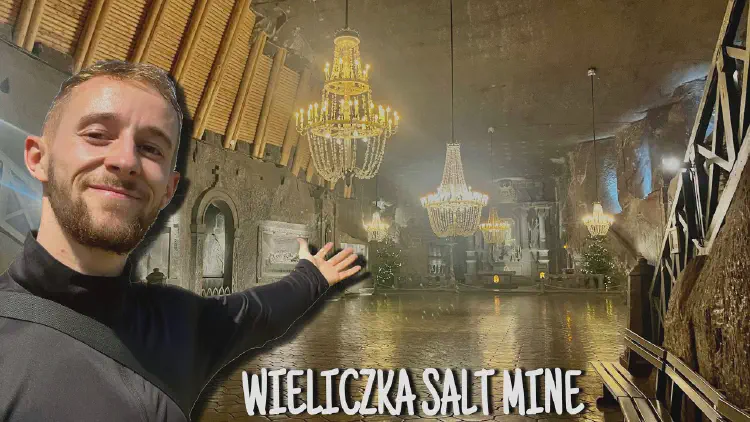
After navigating more dimly lit passages, we arrive at the absolute highlight of the Wieliczka Salt Mine. One hundred meters underground lies the awe-inspiring St. Kinga’s Chapel. This location alone is worth the price of admission. It is, in essence, a fully functional underground church, once used by the miners, sculpted with breathtaking detail entirely out of salt.
The chapel is adorned with intricate salt sculptures and reliefs depicting various religious scenes, including a stunning recreation of The Last Supper. Every detail, from the altar to the floor tiles, is carved from the rock salt.
Adding to the splendor are numerous chandeliers hanging from the ceiling. Incredibly, these too are made from salt. The specific material is halite, a very pure form of salt crystal whose transparency makes it perfect for such ornate fixtures. The sheer beauty and scale of this space, carved by the hands of miners, is a wonder to behold. You can even get married here, an unforgettable venue for a wedding.
Leaving the chapel, the tour is far from over. After passing a glowing green brine lake—with a salt content so high it’s said to be impossible to drown in—we enter the Michalowice Chamber. This space is arguably as jaw-dropping as the chapel, filled with a colossal, interlocking wooden structure that stretches up to a seemingly endless ceiling. This chamber can be hired for small concerts, offering a unique acoustic experience for up to 100 people.
The tour concludes in the Stanisław Staszic Chamber, the tallest in the entire mine, measuring an impressive 36 meters from floor to ceiling. It’s a final, powerful reminder of the immense scale of this underground world, a fitting end to an unforgettable journey through endless chambers and passageways.
Planning Your Visit from Krakow
For those inspired to visit, the mine is about a 30-minute drive from Krakow.
- Booking: It’s highly recommended to book a guided tour in advance. Apps like GetYourGuide offer numerous options.
- Cost: Expect to pay around £40 (€45) per person for a guided tour that includes transportation to and from Krakow.
- Combined Tours: If you also plan to visit Auschwitz, consider a combined day tour. While it makes for a long day, it’s an efficient way to see both must-see sites if your time in Krakow is limited.
Thank you for joining this incredible journey through the Wieliczka Salt Mine. It’s a place where history, art, and nature converge in the most spectacular way.